Pricing Multi-Period Insurance Risk

The next table aggregates posts related to my upcoming monograph Pricing Multi-Period Insurance Risk.
Pricing Multi-Period Insurance Risk Purpose and Introduction
In 2022, John Major and I published Pricing Insurance Risk: Theory and Practice (Wiley, 2022)2. PIR takes a one-period, nominal view of pricing. Since then, I have been working on a successor volume Pricing Multi-Period Insurance Risk (PMIR) to incorporate the effects of loss emergence, loss payment lags, and investment income.
The PMIR monograph presents two practical and tested frameworks to determine marginal costs by unit based on a business plan, a starting balance sheet, and an overall profit target, and describes how to incorporate those costs into rates reflecting time value of money and loss emergence (reserve) uncertainty. The resulting pricing framework produces explainable costs that respond appropriately to each unit’s ultimate loss volatility, payout pattern, and loss emergence profile under a variety of risk appetite assumptions. It extends well-understood single-period pricing frameworks to the multi-period context inherent in most non-life insurance products.
Pricing multi-period insurance risk is the quantum gravity of actuarial science, trying to unify static, intra-temporal point-in-time account-level predictive modeling with evolving, inter-temporal reserving and portfolio risk management. A theoretically perfect solution is likely impractical, as it would require computationally intractable path dependent stochastic-on-stochastic nested simulations and my initial ambition to present such a solution proved infeasible. Instead, this monograph presents a framework that is practical, implementable, consistent with modern accounting principles like IFRS 17, and a demonstrable improvement over many current practices. The solution is “wrong” but “useful” model in Box’s famous aphorism. It consciously cuts corners by ignoring certain technical niceties, but the niceties are second-order effects swamped out by inherent parameter uncertainty.
I call the two frameworks DMC and P2P. The first is the Decoupled Marginal Cost. It can be regarded as a multi-period extension of the single-period, top-down [1] approach using spectral risk measures (SRMs) described in [2]. The core idea is to price the risk that is transferred to capital providers on a one-year basis. The framework proceeds as follows:
- Set a Target: Establish an overall target return for the firm for the upcoming calendar year under the relevant accounting convention.
- Model CY Losses: Using the calendar year decoupling, transform simulated ultimate loss distributions by business unit (both new business and reserves) into a simulated distribution of total net calendar year incurred loss.
- Calibrate the SRM: We calibrate a family of SRMs—flexible pricing tools that encode the market’s risk appetite—so that they produce the required profit target when applied to the total CY loss distribution and are consistent with the firm’s capital structure. These SRMs are then held fixed and provide a range of indications.
- Marginal Costs: Compute marginal costs by business unit using the SRMs’ natural (Euler) allocations. These add up to the total CY profit requirement by Euler’s theorem.
- Ratemaking: Set rates to produce the required targets when combined with time value of money.
DMC is sensitive to individual unit volatility, payout, and emergence characteristics within the whole portfolio, the market risk appetite encapsulated in each SRM, and prevailing macroeconomic variables. It relies on standard capital model simulations, explicitly accounts for time value of money through discounting, and is consistent with the one-year risk view of modern regulatory (Solvency II) and accounting (IFRS 17) frameworks. Discounting to be “turned off” to replicate US GAAP if desired. The model is typically applied to an adjusted portfolio so that results are independent of current reserve positions.
The second framework is the Policy to (2) buy a Policy method. P2P bootstraps a one-period pricing rule, buying at time \(T-1\) a one-year policy conditional on information at time \(T-1\), for the remaining risk that will emerge by ultimate time \(T\). The cost of this policy can be insured by buying a policy at time \(T-2\), and so forth back to time \(0\). It is the accident year ultimate view, to DMC’s calendar year view. It is more appropriate for a closed block of business, such as a catastrophe bond, rather than a going-concern. It is philosophically aligned with finance’s hedging and cost of a replicating portfolio method, the basis for Black-Scholes. Unlike DMC, P2P is standard in the literature.
Core Ideas / Why Read the Monograph
- The risk nexus: volatility, timing, emergence, tolerance
- The mysterious emergence-modeling lacuna
- Decoupled distributions
- You do need to discount; it is not a slippery slope
- Charge amortization against investment income = statutory “investment income on policyholder’s funds”
- Use a liquidity adjusted discount rate, not the risk-free rate
- \(g\)-Economies and derivation of the cost of risk from economy-wide risk tolerance aggregation
- Spectral risk measures
- Linear natural allocation gives the marginal cost
- Kappa
- Central role for marginal cost
- Range of reasonable prices vs. single “correct” price
- Role for negotiation and brokers; finding the best home for a risk
- DMC and P2P as CY and AY benchmarks
- Information as a rating variable
- The value of information varies with risk appetite (hence different firms specialize in short- or long-tail business)
- Information flow and risk are multifaceted; there are no universally true statements
- Information flow is very complicated and interacts with risk appetite
PMIR Overview
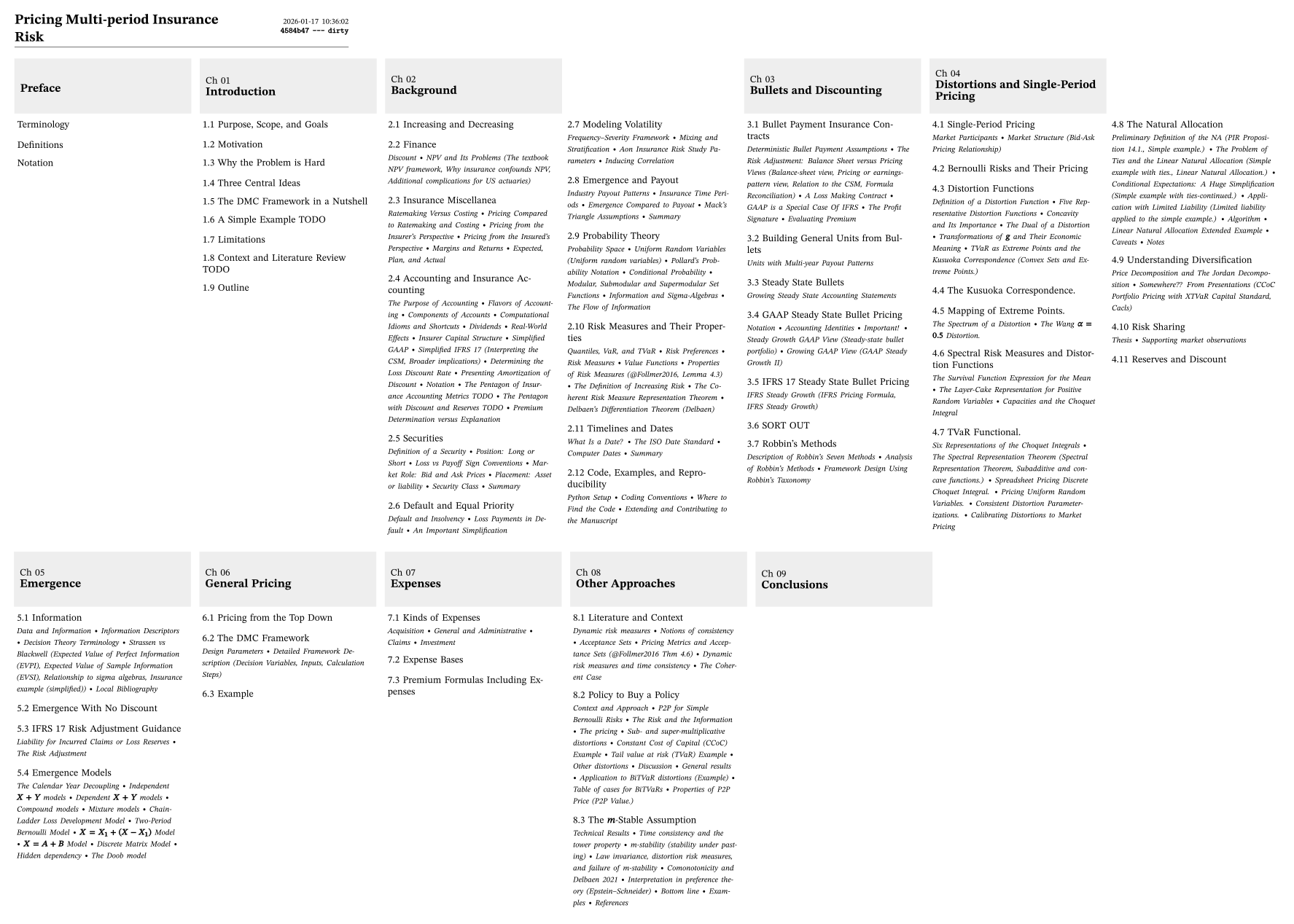
Chapters
- 01: Introduction
- 02: Background
- 03: Bullets and Discounting
- 04: Distortions and Single-Period Pricing
- 05: Emergence
- 06: General Pricing
- 07: Expenses
- 08: Other Approaches
- 09: Conclusions
Chapter and Section Detail
References
Footnotes
The Status column reflects the level of development:
- WORKING = working notes towards a section.
- DRAFT = alpha quality draft, incomplete.
- BETA = beta release quality, may have placeholders.
- RELEASE = release candidate quality, no placeholders.
- FINAL = Completed!
- BACKGROUND = related content, not necessarily part of PMIR.