LSC and USC
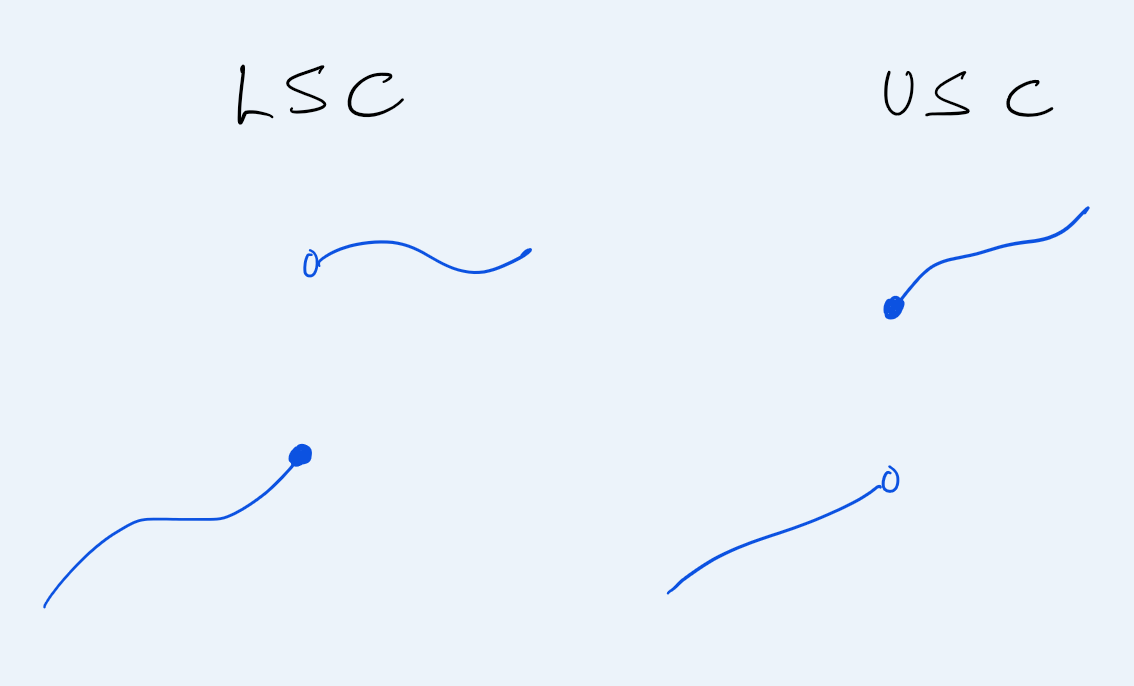
Let \(f:\mathbb R\to\mathbb R\cup\set{\infty}\) be an extended-real-valued function.
LSC = lower semicontinuous
may jump up1 but cannot jump down
\(f\) is lower semicontinuous at \(x_0\) if \[ f(x_0) \le \liminf_{x\to x_0} f(x). \]
Heuristically: \(f\) cannot jump downward at \(x_0\), but it may jump upward.
Equivalent characterizations:
- \(\{x : f(x) \le y\}\) is closed for every \(y\)
- \(\{x : f(x) > y\}\) is open for every \(y\)
- the epigraph \(\{(x,t): t \ge f(x)\}\) is closed (or the region above the graph)
Examples:
- \(\lfloor x \rfloor\)
- Usual indicator (\(0/1\) function) on a open2 set.
- Convex indicator \(\delta_F(x)=0\) for \(x\in F\), \(\infty\) otherwise, with \(F\) closed
- Many integral functionals LSC by Fatou’s lemma, \(\int\liminf f_n\le \liminf\int f\)
Facts:
- an LSC function attains its minimum on a compact set
- every LSC function is the pointwise limit of an increasing sequence of continuous functions
Memory:
If you “look at the lower part of the graph” near \(x_0\) it looks continuous. Look at lower part means “cover the top”.
USC = upper semicontinuous
may jump down but cannot jump up
\(f\) is upper semicontinuous at \(x_0\) if \[ f(x_0) \ge \limsup_{x\to x_0} f(x). \]
Heuristically: \(f\) cannot jump upward at \(x_0\), but it may jump downward.
Equivalent characterizations:
- \(\{x : f(x) \ge y\}\) is closed for every \(y\)
- \(\{x : f(x) < y\}\) is open for every \(y\)
- the hypograph \(\{(x,t): t \le f(x)\}\) is closed (or the region below the graph)
Examples:
- \(\lceil x \rceil\)
- Usual indicator on a closed set
- \(-\delta_G\), or the \(0/-\infty\) indicator of an open set \(G\)
Facts:
- a USC function attains its maximum on a compact set
- every USC function is the pointwise limit of a decreasing sequence of continuous functions
Memory:
If you “look at the upper part of the graph” near \(x_0\) it looks continuous. Look at upper part means “cover the bottom”.
Relationships
- pointwise supremum of LSC functions is LSC
- pointwise infimum of USC functions is USC
Interior Continuity
Any convex function \(f: \mathbb{R}^n \to \mathbb{R}\) is locally Lipschitz continuous in the relative interior of its domain. In plain English: a convex function is always continuous inside its domain. You cannot have a “jump” in the middle of a convex function’s domain. If you tried to create a jump at \(x=0.5\) for a function defined on \([0, 1]\), the “line segment” requirement of convexity would immediately force the values on one side of the jump to rise or fall to meet the other side, smoothing it out.
Another example: take \(f(x)=-\sqrt{1 - x^2}\) on \(|x|<1\) and \(\infty\) elsewhere, so \(f\) jumps down on \(|x|=1\) and is not LSC. This is a two-dimension analog jumps up on a circle.
Footnotes
For example, take \(f\) the function \(f(x)=0\) for \(x \in [0,1]\) and \(f(x)=1\) otherwise. The points \(x=0,1\) are jumps, and the value jumps up. Approaching \(x\downarrow 1\) or \(x \uparrow 0\) there is no surprise jump—though obviously there is eventually! If \(x>1\) then \(f(x')=0\) for all \(x'\) near \(x\) and similarly for \(x<0\). On the other hand, if \(g(x)=0\) for \(x\in(0,1)\) and \(1\) otherwise, the jumps are downwards. The function \[ h(x)=\begin{cases} 0 & 0 \le x < 1 \\ 1 & x = 1 \\ 2 & x \not\in [0,1] \end{cases} \] is neither LSC nor USC. At \(x=1\) it has a jump up and a jump down. The epigraph (region above the graph) is not closed because it is missing the line from \((1,0)\) to \((1,1)\). The hypograph (below) is not closed because it is missing the line from \((1,1)\) to \((1,2)\).↩︎
For example, consider the indicator \(I\) on \((0,1)\). If \(c=0.5\) then \(\set{I \le c}=(-\infty, 0]\cup[1,\infty)\) is closed and \(\set{I>c}=(0,1)\) is open. Notice the open/closed condition flips for \(0/1\) and convex \(0/\infty\) indicator functions.↩︎