The DDGR (Denuit, Dhaene, Ghossoub, and Robert) algorithm for a comonotonic allocation.
Author
Stephen J. Mildenhall
Published
2026-03-11
Modified
2026-03-11
Mildenhall and Major (2022) discusses kappa functions, likely the most important risk functions you’ve never heard of. If \(X=\sum_i X_i\) is an insurance loss portfolio decomposed by unit \(i\) and defined on a probability space \((\Omega, \mathsf P)\), then \[
\kappa_i := \mathsf P(X_i \mid X)
\] (i.e., the conditional expectation \(\mathsf E(X_i \mid X)\), but I’m eschewing \(\mathsf E\) notation in favor of the more transparent and informative \(\mathsf P\), following advice from Pollard (2002) and practice in many other fields of mathematics). As a random variable, \[
\kappa_i(\omega) = \mathsf P(X_i \mid X)(\omega) = \mathsf P(X_i \mid X=X(\omega)).
\]M. M. Denuit and Dhaene (2012) call \(\kappa_i\) the Conditional Mean Risk-Sharing (CMRS) allocation.
Kappa functions are important because an insurer is indifferent whether you insure \(X_i\) or \(\kappa_i\). Their total loss is the same in either case. If the insurer prices with a risk functional \(\rho\) then \(\rho(\kappa_i)\) is often a good premium estimate—it looks stand-alone but gets rid of idiosyncratic and irrelevant process risk. Since \(\kappa_i\) is less risky than \(X_i\), any reasonable \(\rho\) should have \[
\rho(\kappa_i) \le \rho(X_i).
\] Less risky is meant in the sense of second order stochastic dominance (SSD), and hence of all three of the non-variance measures in Rothschild and Stiglitz (1970). Spectral risk measures, derived from distortion functions, preserve SSD. This looks like a big pricing simplification, but the simplification is a bit of a cheat since you need to know the multivariate distribution of the \(X_i\) to compute \(\kappa_i\). However, \(\kappa\)s are a very helpful mental picture of risk and are often good at explaining how \(\rho\) prices.
When \(\rho\) is spectral, associated with the distortion \(g\), we write the risk functional as \[
g(X) := \int_0^\infty g(\mathsf P(X > t))\,dt
\] rather than \(\rho(X)\) to avoid a hidden \(g\) or the redundant \(\rho_g\). It is well known there exists a \(Z\), \(Z\ge 0\), \(\mathsf P(Z)=1\) so that \[
g(X) = \mathsf P(XZ),
\tag{1}\] see Mildenhall and Major (2022), terms and conditions apply. Equation 1 leads naturally to the natural allocation of premium \[
g_X(X_i) := \mathsf P(X_iZ).
\tag{2}\] The natural allocation can be interpreted as the marginal cost (Delbaen 2000), and it also generalizes the idea of conditional measures like coTVaR. The function \(Z\) can be taken to be \(X\)-measurable and comonotonic with \(X\), and is morally unique (Cherny and Orlov 2011). \(Z\) is called the (linear) contact function for \(g\) at \(X\).
If \(\kappa_i\) are all comonotonic with \(X\), then a contact function for \(g\) at \(X\) is also a contact function for each \(\kappa_i\). Therefore, since \(Z\) is \(X\)-measurable, \[
\begin{aligned}
g(\kappa_i)
&= \mathsf P(\kappa_iZ) \\
&= \mathsf P(\mathsf P(X_i\mid X)Z) \\
&= \mathsf P(X_iZ) \\
&= g_X(X_i)
\end{aligned}
\] and the stand-alone price of \(\kappa_i\) equals the natural allocation to \(X_i\), a very satisfying result. The comonotonic condition on \(\kappa_i\) holds when all \(X_i\) have thin tails (Efron 1965), but not in general. For example, it often fails when one \(X_i\) has a thicker tail than the others, see M. M. Denuit et al. (2025) and my blog post discussing it.
In the \(\kappa_i\) allocation of \(X\), each \(\kappa_i\) is less risky than \(X_i\): the allocation is said to dominate the original allocation \(X=\sum_i X_i\) in convex order. It is well known that any allocation is convex-order-dominated by a comonotonic allocation. This was first proved in Landsberger and Meilijson (1994) in restricted situations. It would be nice to have a way to convert \(\kappa_i\) into a comonotonic allocation. Alas, none of the existing proofs are explicit enough to allow for an easy algorithmic implementation in practice. Until now: enter the recent paper M. Denuit et al. (2025). It uses alternative approach, based on the theory of majorization and an extension of a result of Lorentz and Shimogaki (1968), to provide an explicit algorithmic construction that is easy to implement. I have added the DDGR algorithm (Denuit, Dhaene, Ghossoub, and Robert) to my risk modeling Python package aggregate (in release 0.30).
Here is how to use aggregate to reproduce the example from M. Denuit et al. (2025). The DDGR algorithm is simple but necessarily not quick and can result in a lot of back-tracking for long runs of decreasing \(\kappa_i\). Therefore, you should install numba to pre-compile the numerical implementation. When numba is installed, compilation occurs automatically. It provides minutes-to-seconds speedups.
The text below replicates Section 3.2, other than color and figure number changes. Note, the paper uses \(S\) where we use \(X\).
Here we provide a simple example that illustrates the algorithmic approach suggested in the proof of Theorem 3.1 [DDGM algo]. Suppose, for the sake of illustration, that \(n = 3\). Let \(\mathcal{X} \subset L^2_+(\Omega, \mathcal{F}, \mathbb{P})\) denote an ex-ante given collection of potential risks under interest, where \((\Omega, \mathcal{F}, \mathbb{P})\) is a nonatomic probability space. The initial random endowment is the vector \(\mathbf{X}_0 = (X_{0,1}, X_{0,2}, X_{0,3}) \in \mathcal{X}^3\), representing the risks faced by the 3 agents individually, before any risk sharing takes place. The pool’s aggregate risk is \(S := X_{0,1} + X_{0,2} + X_{0,3}\), and the set of feasible allocations is \[
\mathcal{A} = \left\{ \mathbf{X} = (X_1, X_2, X_3) \in \mathcal{X}^3 \;\middle|\; X_1 + X_2 + X_3 = S \right\}.
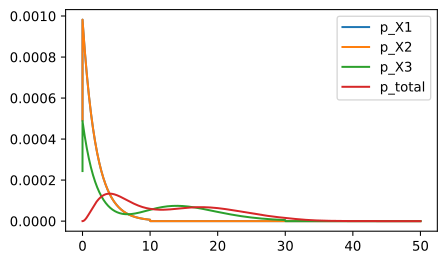
\] We assume, for the sake of illustration, that the components of \(\mathbf{X}_0\) are independent. \(X_{0,1}\) and \(X_{0,2}\) follow a truncated exponential distribution with parameter \(\beta > 0\) on the interval \([0, M]\), for some given \(M < +\infty\), with a probability density function \(f\) given by \(f(x) := \dfrac{\beta e^{-\beta x}}{1 - e^{-\beta M}}\), for \(x \in [0, M]\). For some given \(N < +\infty\), \(X_{0,3}\) follows on the interval \([0, N]\) a truncated mixture of an exponential distribution with parameter \(\beta > 0\) and a gamma distribution with parameters \(\alpha > 1\) and \(\beta > 0\), with equal mixing weights 0.5. The probability density function \(g\) of \(X_{0,3}\) is then given by \[
g(x) := \frac{(\beta + \beta^\alpha x^{\alpha-1} / \Gamma(\alpha)) e^{-\beta x}}{\int_0^N (\beta + \beta^\alpha x^{\alpha-1} / \Gamma(\alpha)) e^{-\beta x} dx},
\] for \(x \in [0, N]\). For the numerical illustration, we take \(\beta = 1/2\), \(M = 10\), \(\alpha = 8\), and \(N = 30\).
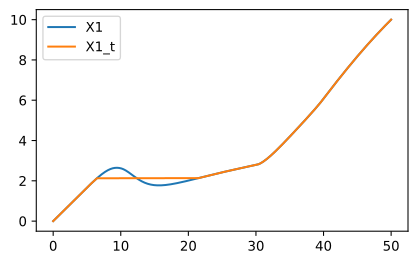
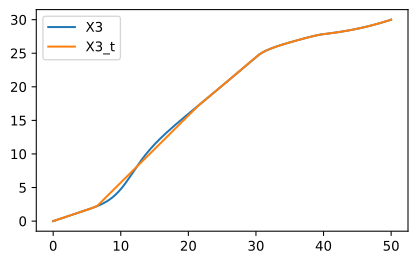
Figure 1 provides the probability density function of the aggregate risk \(S\), as well as a plot of the agents’ allocations (Figure 2, Figure 3). The initial allocations considered at the beginning of the algorithm are the CMRS allocations \(\mathbf{X}_0\) characterized by the functions \(s \mapsto \mathbb{E}[X_{0,i} | S = s]\), for agent \(i \in \{1, 2, 3\}\) (black lines). We note that the allocation functions of agents 1 and 2 are not increasing in \(s\), and so the CMRS allocations are not comonotonic, and a fortiori not Pareto optimal. We therefore implement the algorithm presented in the previous section in order to obtain a comonotonic improvement. The final allocation functions (orange lines) become non-decreasing functions in \(s\), thereby leading to a comonotonic and hence Pareto-optimal allocation vector. The algorithm replaced, on an interval including the decreasing parts of agents 1 and 2, the initial functions by constant functions, while preserving the expectations of the allocations and guaranteeing the component-wise convex-order improvement of the allocation vector.
Here is the code to replicate the example. aggregate uses parameter \(1/\beta\) rather than \(\beta\) for the exponential. Note the use of splice in the custom code (DecL) to limit losses from each marginal, and the ease with which the software handles the exponential / gamma mixture for \(X_3\). See aggregate help and the paper Mildenhall (2024) for more about using aggregate. The software uses FFTs to convolve the distributions and compute \(\kappa_i\). Distributions are discretized using \(2^{16}=65536\) buckets and a discretization step \(h=1/512=0.001953125\).
The code for the implementation was produced directly from the paper PDF by Gemini 3.1 in Pro mode. It is included in aggregate build 0.30. See the GitHub repo
from numba import njitimport numpy as np@njitdef make_comonotonic_allocations(s_grid: np.ndarray, pdf_s: np.ndarray, kappa: np.ndarray) -> np.ndarray:""" Computes a comonotonic convex-order improvement for an allocation matrix. Implements the algorithmic convex-order improvement from Theorem 3.1 in Denuit et. al. Uses a majorization approach based on Lorentz and Shimogaki (1968) to flatten monotonicity violations and redistribute mass . Reference --------- Denuit, Michel, et al. "Comonotonicity and Pareto optimality, with application to collaborative insurance." Insurance: Mathematics and Economics 120 (2025): 1-16. Parameters ---------- s_grid : np.ndarray 1D array of length M representing the discretized aggregate sum $S$. pdf_s : np.ndarray 1D array of length M containing the probability mass function of $S$. kappa : np.ndarray 2D array of shape (N, M) where N is the number of individual risks and M is the length of s_grid. Represents the initial Conditional Mean Risk-Sharing (CMRS) allocations $X_i^0 = \\mathsf{E}[X_i | S]$. Returns ------- np.ndarray 2D array of shape (N, M) containing the comonotonic allocations $\\tilde{f}_i(S)$. """ n, m = kappa.shape kappa_tilde = np.copy(kappa)# Sweep forward through the aggregate states Sfor k inrange(1, m):# Calculate local slopes to check for monotonicity diffs = kappa_tilde[:, k] - kappa_tilde[:, k-1]# Identify components where the allocation decreases as S increases violators = np.where(diffs <0)[0]iflen(violators) >0: non_violators = np.where(diffs >=0)[0]for i in violators: p = k -1 mass = pdf_s[k] weighted_sum = kappa_tilde[i, k] * mass# Scan backward to find the pooling index p that restores# monotonicity by creating an integral average (lambda_val)# that bounds the previous stepswhile p >=0and kappa_tilde[i, p] > (weighted_sum / massif mass >0else kappa_tilde[i, k]): weighted_sum += kappa_tilde[i, p] * pdf_s[p] mass += pdf_s[p] p -=1 p +=1if mass >0: lambda_val = weighted_sum / masselse: lambda_val = kappa_tilde[i, k]# delta represents the mass removed from the violator to flatten it delta = kappa_tilde[i, p:k +1] - lambda_val kappa_tilde[i, p:k +1] = lambda_valiflen(non_violators) >0: slopes = diffs[non_violators] sum_slopes = np.sum(slopes)# Compute redistribution weights proportional to positive# slopes to prevent non-violators from breaking monotonicityif sum_slopes >0: alpha = slopes / sum_slopeselse: alpha = np.ones(len(non_violators)) /len(non_violators)# Redistribute the removed mass to the non-violating componentsfor idx, j inenumerate(non_violators): kappa_tilde[j, p:k +1] += delta * alpha[idx]return kappa_tilde
Denuit, M. M., & Dhaene, J. (2012). Convex order and comonotonic conditional mean risk sharing. Insurance: Mathematics and Economics, 51(2), 265–270. https://doi.org/10.1016/j.insmatheco.2012.04.005
Denuit, M. M., Ortega-Jiménez, P., & Robert, C.-Y. (2025). Conditional expectations given the sum of independent random variables with regularly varying densities. ASTIN Bulletin, 55(2), 449–485. https://doi.org/10.1017/asb.2025.11
Denuit, M., Dhaene, J., Ghossoub, M., & Robert, C. Y. (2025). Comonotonicity and Pareto optimality, with application to collaborative insurance. Insurance: Mathematics and Economics, 120, 1–16. https://doi.org/10.1016/j.insmatheco.2024.11.001
Landsberger, M., & Meilijson, I. (1994). Co-monotone allocations, Bickel-Lehmann dispersion and the Arrow-Pratt measure of risk aversion. Annals of Operations Research, 52(2), 97–106. https://doi.org/10.1007/BF02033185
Lorentz, G. G., & Shimogaki, T. (1968). Interpolation theorems for operators in function spaces. Journal of Functional Analysis, 2(1), 31–51. https://doi.org/10.1016/0022-1236(68)90024-4
Mildenhall, S. J. (2024). Aggregate: fast, accurate, and flexible approximation of compound probability distributions. Annals of Actuarial Science, 1–40. https://doi.org/10.1017/S1748499524000216
Mildenhall, S. J., & Major, J. A. (2022). Pricing Insurance Risk: Theory and Practice. John Wiley & Sons, Inc. https://doi.org/10.1002/9781119756538
---author: Stephen J. Mildenhalltitle: Comonotonicity and Pareto Optimalitydescription: 'The DDGR (Denuit, Dhaene, Ghossoub, and Robert) algorithm for a comonotonic allocation.'categories:- notes- mathematics- llm- riskdate: '2026-03-11'date-modified: last-modifieddraft: falseimage: img/banner.pngnumber-sections: falseformat: html: code-tools: true code-fold: true pdf: documentclass: article papersize: a4 fontsize: 10pt keep-tex: true geometry: margin=1in reference-section-title: 'References' include-in-header: ../prefob.tex toc: false number-sections: false pdf-engine: tectonic colorlinks: true link-citations: true link-bibliography: truebibliography: C:/s/TELOS/Biblio/uber-library.bibcsl: C:/s/TELOS/Biblio/journal-of-risk-and-uncertainty.csl---{width=33%}@Mildenhall2022a discusses kappa functions, likely the most important risk functions you've never heard of. If $X=\sum_i X_i$ is an insurance loss portfolio decomposed by unit $i$ and defined on a probability space $(\Omega, \mathsf P)$, then$$\kappa_i := \mathsf P(X_i \mid X)$$(i.e., the conditional expectation $\mathsf E(X_i \mid X)$, but I'm eschewing $\mathsf E$ notation in favor of the more transparent and informative $\mathsf P$, following advice from @Pollard2002 and practice in many other fields of mathematics). As a random variable,$$\kappa_i(\omega) = \mathsf P(X_i \mid X)(\omega) = \mathsf P(X_i \mid X=X(\omega)).$$@Denuit2012 call $\kappa_i$ the Conditional Mean Risk-Sharing (CMRS) allocation.Kappa functions are important because an insurer is indifferent whether you insure $X_i$ or $\kappa_i$. Their total loss is the same in either case. If the insurer prices with a risk functional $\rho$ then $\rho(\kappa_i)$ is often a good premium estimate---it looks stand-alone but gets rid of idiosyncratic and irrelevant process risk. Since $\kappa_i$ is less risky than $X_i$, any reasonable $\rho$ should have$$\rho(\kappa_i) \le \rho(X_i).$$Less risky is meant in the sense of second order stochastic dominance (SSD), and hence of all three of the non-variance measures in @Rothschild1970. Spectral risk measures, derived from distortion functions, preserve SSD. This looks like a big pricing simplification, but the simplification is a bit of a cheat since you need to know the multivariate distribution of the $X_i$ to compute $\kappa_i$. However, $\kappa$s are a very helpful mental picture of risk and are often good at explaining how $\rho$ prices.When $\rho$ is spectral, associated with the distortion $g$, we write the risk functional as$$g(X) := \int_0^\infty g(\mathsf P(X > t))\,dt$$rather than $\rho(X)$ to avoid a hidden $g$ or the redundant $\rho_g$. It is well known there exists a $Z$, $Z\ge 0$, $\mathsf P(Z)=1$ so that$$g(X) = \mathsf P(XZ),$$ {#eq-cf}see @Mildenhall2022a, terms and conditions apply. @eq-cf leads naturally to the natural allocation of premium$$g_X(X_i) := \mathsf P(X_iZ).$$ {#eq-na}The natural allocation can be interpreted as the marginal cost [@Delbaen2000], and it also generalizes the idea of conditional measures like coTVaR. The function $Z$ can be taken to be $X$-measurable and comonotonic with $X$, and is morally unique [@Cherny2011]. $Z$ is called the (linear) contact function for $g$ at $X$.If $\kappa_i$ are all comonotonic with $X$, then a contact function for $g$ at $X$ is also a contact function for each $\kappa_i$. Therefore, since $Z$ is $X$-measurable,$$\begin{aligned}g(\kappa_i)&= \mathsf P(\kappa_iZ) \\&= \mathsf P(\mathsf P(X_i\mid X)Z) \\&= \mathsf P(X_iZ) \\&= g_X(X_i)\end{aligned}$$and the stand-alone price of $\kappa_i$ equals the natural allocation to $X_i$, a very satisfying result. The comonotonic condition on $\kappa_i$ holds when all $X_i$ have thin tails [@Efron1965], but not in general. For example, it often fails when one $X_i$ has a thicker tail than the others, see @Denuit2025b and [my blog post](/posts/notes/2024-04-04-Conditional-Expectations-Given-The-Sum-of-Independent-Random-Variables-with-Regularly-Varying-Densities) discussing it.In the $\kappa_i$ allocation of $X$, each $\kappa_i$ is less risky than $X_i$: the allocation is said to dominate the original allocation $X=\sum_i X_i$ in convex order. It is well known that any allocation is convex-order-dominated by a comonotonic allocation. This was first proved in @Landsberger1994 in restricted situations. It would be nice to have a way to convert $\kappa_i$ into a comonotonic allocation. Alas, none of the existing proofs are explicit enough to allow for an easy algorithmic implementation in practice. Until now: enter the recent paper @Denuit2025a. It uses alternative approach, based on the theory of majorization and an extension of a result of @Lorentz1968, to provide an explicit algorithmic construction that is easy to implement. I have added the DDGR algorithm (Denuit, Dhaene, Ghossoub, and Robert) to my risk modeling Python package [`aggregate` (in release 0.30)](https://github.com/mynl/aggregate).### Example [@Denuit2025a Section 3.2]Here is how to use `aggregate` to reproduce the example from @Denuit2025a. The DDGR algorithm is simple but necessarily not quick and can result in a lot of back-tracking for long runs of decreasing $\kappa_i$. Therefore, you should install `numba` to pre-compile the numerical implementation. When `numba` is installed, compilation occurs automatically. It provides minutes-to-seconds speedups.**The text below replicates Section 3.2, other than color and figure number changes. Note, the paper uses $S$ where we use $X$.**---Here we provide a simple example that illustrates the algorithmic approach suggested in the proof of Theorem 3.1 [DDGM algo]. Suppose, for the sake of illustration, that $n = 3$. Let $\mathcal{X} \subset L^2_+(\Omega, \mathcal{F}, \mathbb{P})$ denote an ex-ante given collection of potential risks under interest, where $(\Omega, \mathcal{F}, \mathbb{P})$ is a nonatomic probability space. The initial random endowment is the vector $\mathbf{X}_0 = (X_{0,1}, X_{0,2}, X_{0,3}) \in \mathcal{X}^3$, representing the risks faced by the 3 agents individually, before any risk sharing takes place. The pool's aggregate risk is $S := X_{0,1} + X_{0,2} + X_{0,3}$, and the set of feasible allocations is$$\mathcal{A} = \left\{ \mathbf{X} = (X_1, X_2, X_3) \in \mathcal{X}^3 \;\middle|\; X_1 + X_2 + X_3 = S \right\}.$$We assume, for the sake of illustration, that the components of $\mathbf{X}_0$ are independent. $X_{0,1}$ and $X_{0,2}$ follow a truncated exponential distribution with parameter $\beta > 0$ on the interval $[0, M]$, for some given $M < +\infty$, with a probability density function $f$ given by $f(x) := \dfrac{\beta e^{-\beta x}}{1 - e^{-\beta M}}$, for $x \in [0, M]$. For some given $N < +\infty$, $X_{0,3}$ follows on the interval $[0, N]$ a truncated mixture of an exponential distribution with parameter $\beta > 0$ and a gamma distribution with parameters $\alpha > 1$ and $\beta > 0$, with equal mixing weights 0.5. The probability density function $g$ of $X_{0,3}$ is then given by$$g(x) := \frac{(\beta + \beta^\alpha x^{\alpha-1} / \Gamma(\alpha)) e^{-\beta x}}{\int_0^N (\beta + \beta^\alpha x^{\alpha-1} / \Gamma(\alpha)) e^{-\beta x} dx},$$for $x \in [0, N]$. For the numerical illustration, we take $\beta = 1/2$, $M = 10$, $\alpha = 8$, and $N = 30$.@fig-one provides the probability density function of the aggregate risk $S$, as well as a plot of the agents' allocations (@fig-two, @fig-three). The initial allocations considered at the beginning of the algorithm are the CMRS allocations $\mathbf{X}_0$ characterized by the functions $s \mapsto \mathbb{E}[X_{0,i} | S = s]$, for agent $i \in \{1, 2, 3\}$ (black lines). We note that the allocation functions of agents 1 and 2 are not increasing in $s$, and so the CMRS allocations are not comonotonic, and a fortiori not Pareto optimal. We therefore implement the algorithm presented in the previous section in order to obtain a comonotonic improvement. The final allocation functions (orange lines) become non-decreasing functions in $s$, thereby leading to a comonotonic and hence Pareto-optimal allocation vector. The algorithm replaced, on an interval including the decreasing parts of agents 1 and 2, the initial functions by constant functions, while preserving the expectations of the allocations and guaranteeing the component-wise convex-order improvement of the allocation vector.---Here is the code to replicate the example. `aggregate` uses parameter $1/\beta$ rather than $\beta$ for the exponential. Note the use of `splice` in the custom code (DecL) to limit losses from each marginal, and the ease with which the software handles the exponential / gamma mixture for $X_3$. See [`aggregate` help](https://aggregate.readthedocs.io/) and the paper @Mildenhall2024 for more about using `aggregate`. The software uses FFTs to convolve the distributions and compute $\kappa_i$. Distributions are discretized using $2^{16}=65536$ buckets and a discretization step $h=1/512=0.001953125$.```{python}#| echo: true#| code-fold: false#| label: tbl-one#| tbl-cap: "Portfolio statistics for Example."%config InlineBackend.figure_format ="svg"import numpy as npfrom aggregate import buildfrom greater_tables import GTnp.seterr(invalid='ignore', divide='ignore')beta =2alpha =8M =10N =30port = build(f'''port Ex32 agg X1 1 claim sev {beta} * expon splice [0 {M}] fixed agg X2 1 claim sev {beta} * expon splice [0 {M}] fixed agg X3 1 claim sev {beta} * gamma [1 {alpha}] wts [0.5 0.5] splice [0 {N}] fixed''')GT(port.describe, hrule_widths=(1,0,0), table_font_pt_size=10, tikz_scale=0.85)``````{python}#| echo: true#| code-fold: true#| label: fig-one#| fig-cap: "Loss densities by unit."bit = port.density_df.loc[:50].filter(regex='^p_')bit.plot(figsize=(5,3))``````{python}#| echo: true#| code-fold: true#| label: fig-two#| fig-cap: "$\\kappa_1$ and $\\tilde \\kappa_1$."df = port.make_comonotonic_allocations()df = df.rename(columns=lambda x: x.replace('exeqa_', ''))df.filter(regex='X1').plot(figsize=(5,3))``````{python}#| echo: true#| code-fold: true#| label: fig-three#| fig-cap: "$\\kappa_3$ and $\\tilde \\kappa_3$."df.filter(regex='X3').plot(figsize=(5,3))```### Source CodeThe code for the implementation was produced directly from the paper PDF by Gemini 3.1 in Pro mode. It is included in `aggregate` build 0.30. See the [GitHub repo](https://github.com/mynl/aggregate)```pythonfrom numba import njitimport numpy as np@njitdef make_comonotonic_allocations(s_grid: np.ndarray, pdf_s: np.ndarray, kappa: np.ndarray) -> np.ndarray:""" Computes a comonotonic convex-order improvement for an allocation matrix. Implements the algorithmic convex-order improvement from Theorem 3.1 in Denuit et. al. Uses a majorization approach based on Lorentz and Shimogaki (1968) to flatten monotonicity violations and redistribute mass . Reference --------- Denuit, Michel, et al. "Comonotonicity and Pareto optimality, with application to collaborative insurance." Insurance: Mathematics and Economics 120 (2025): 1-16. Parameters ---------- s_grid : np.ndarray 1D array of length M representing the discretized aggregate sum $S$. pdf_s : np.ndarray 1D array of length M containing the probability mass function of $S$. kappa : np.ndarray 2D array of shape (N, M) where N is the number of individual risks and M is the length of s_grid. Represents the initial Conditional Mean Risk-Sharing (CMRS) allocations $X_i^0 = \\mathsf{E}[X_i | S]$. Returns ------- np.ndarray 2D array of shape (N, M) containing the comonotonic allocations $\\tilde{f}_i(S)$. """ n, m = kappa.shape kappa_tilde = np.copy(kappa)# Sweep forward through the aggregate states Sfor k inrange(1, m):# Calculate local slopes to check for monotonicity diffs = kappa_tilde[:, k] - kappa_tilde[:, k-1]# Identify components where the allocation decreases as S increases violators = np.where(diffs <0)[0]iflen(violators) >0: non_violators = np.where(diffs >=0)[0]for i in violators: p = k -1 mass = pdf_s[k] weighted_sum = kappa_tilde[i, k] * mass# Scan backward to find the pooling index p that restores# monotonicity by creating an integral average (lambda_val)# that bounds the previous stepswhile p >=0and kappa_tilde[i, p] > (weighted_sum / massif mass >0else kappa_tilde[i, k]): weighted_sum += kappa_tilde[i, p] * pdf_s[p] mass += pdf_s[p] p -=1 p +=1if mass >0: lambda_val = weighted_sum / masselse: lambda_val = kappa_tilde[i, k]# delta represents the mass removed from the violator to flatten it delta = kappa_tilde[i, p:k +1] - lambda_val kappa_tilde[i, p:k +1] = lambda_valiflen(non_violators) >0: slopes = diffs[non_violators] sum_slopes = np.sum(slopes)# Compute redistribution weights proportional to positive# slopes to prevent non-violators from breaking monotonicityif sum_slopes >0: alpha = slopes / sum_slopeselse: alpha = np.ones(len(non_violators)) /len(non_violators)# Redistribute the removed mass to the non-violating componentsfor idx, j inenumerate(non_violators): kappa_tilde[j, p:k +1] += delta * alpha[idx]return kappa_tilde```