An Atlas of Risk Measures organizes risk measures along two important dimensions: how a measure treats diversification, and how well it behaves under limits. The Atlas unifies expected value, spectral measures, coherent and convex risk measures, Value at Risk, and stranger finitely additive objects that usually stay offstage. The Atlas turns a technically dense literature into a map: it shows where the main examples live, what assumptions move you from one region to another, and why convex duality, the Fatou property, and law invariance matter so much. The result is an appealing visual tour of modern risk measure theory from an actuarial, pricing-centered point of view.
The Atlas and Associated Figures
Atlas of Risk Measures
Figure 1: Atlas of risk measures. Continuity increases down each column and diversification additivity becomes more flexible across each row.
Populated Atlas
Figure 2: Populated atlas.
Relationships Between Properties of Risk Measures
Figure 3: Relationships between properties of risk measures. Source Mildenhall and Major (2022).
Geometric Representations of Penalty Function Epigraphs
Figure 4: Geometric representations of penalty function epigraphs, \(\operatorname{epi}(\rho^*)\), across risk measure classes. The top row illustrates general dual domains, and the bottom row the symmetrically expanded law invariant domain. The columns show increasingly general algebraic additivity conditions, from linearity on the left to convexity on the right.
Atlas Topology
Figure 5: Topology of the dual space \(ba = (L^\infty)^*\). The green sub-region shows the probability measures (positive, total measure 1) within \(ba\). The fractal \(H\)-mesh cartoon illustrates the weak* dense subset of countably additive measures (\(L^1\)) within the broader space of finitely additive measures (\(ba\)). The magnified view demonstrates a sequence of probability densities \((Z_n \in L^1_{1,+})\) converging in the weak* topology to a purely finitely additive measure (\(\mu_{\mathit{pfa}}\)), illustrating the necessity of the extended space \(ba_{1,+}\) for representing general risk measures.
Construction
For a convex, lsc, monetary risk measure \(\rho\) on \(L^\infty\), with \(\alpha\) convex and lsc.
Figure 6: Starting from a convex, lsc \(\alpha\).
Construction (Arbitrary \(\alpha\))
Starting from arbitrary \(\alpha\) convex and lsc, creating \(\alpha_{\min}\).
Figure 7: Starting from an arbitrary \(\alpha\).
Primal axioms and dual restrictions
Figure 8: Primal axioms and corresponding restrictions on the dual function.
Acceptance Sets
Figure 9: Acceptance sets and corresponding risk measure properties. The shaded region represents the acceptance set \(\mathcal A\). Black lines represent the boundary; unbounded region have no boundary line. Only (c) is bounded. The origin is marked with \(0\). Source: Mildenhall and Major (2022).
Continuity Hierarchy
Figure 10: Relationship between continuity concepts for a convex monetary risk measure.
Convergence Concepts
Figure 11: Convergence concepts for random variables.
How To Do Other Things
Bumpf
Too many actuarial pricing models
over-weight tail catastrophe risk, and
under-weight earnings-hit volatility risk.
This behavior drives portfolio steering and reinsurance purchase decisions materially at odds with management’s risk preferences.
Diagnosis
Management’s complaint is entirely explained by an assumption that the cost of capital is constant.
The assumption is often implicit and hidden.
Prescription
Stop assuming the cost of capital is constant!
There are other good alternatives … enter Spectral Risk Measures (SRMs).
Example: Pricing
Keep these numbers in mind!
Market pricing for the total portfolio earns a 15% return on a fully capitalized basis
Premium \(P\), capital \(Q\), total assets \(a=P+Q=\max(L)=100\), and return \(r=0.15\) are related by \[P = \mathsf E[L] + r (a - P) \implies P = v \mathsf E[L] + d\max(L)\] where \(v = 1/(1+r)\) and \(d=r/(1+r)\) are the discount rate and factor
Facts imply \(P=53.565\), loss ratio 87%, and premium to surplus ratio of 1.15:1
---author:- name: Stephen J. Mildenhall roles: writing corresponding: true orcid: 0000-0001-6956-0098 email: mynl@me.com # affiliation: # - name: Unaffiliated Researcher # city: London # country: UKtitle: An Atlas of Risk Measurestitle-block-style: defaultdescription: "A guided tour through the world of risk measures."categories:- notes- mathematics- risk- llmdate: now # '2026-03-25'date-modified: last-modifieddate-format: dddd MMM D, YYYY (HH:mm:ss z)draft: falseformat: html: code-tools: true code-fold: true toc: true toc-depth: 3 beamer: classoption: handout,t # ignore pauses etc. fontsize: 18pt outertheme : metropolis colortheme : orchid filecolor: smcolor fonttheme : structurebold innertheme : metropolis keep-tex: true include-in-header: ../prefob.tex toc: false number-sections: true toc-depth: 1 toc-title: 'Contents' colorlinks: true link-citations: true link-bibliography: true linkcolor: smcolor urlcolor: smcolor slide-level: 2 pdf-engine: tectonic header-includes: - \usepackage{xcolor} - \definecolor{smcolor}{HTML}{3333B2} - \setbeamertemplate{footline}[frame number] - \geometry{paper=a3paper, landscape, truedimen, mag=2000} # \geometry{paper=a3paper, landscape, truedimen, right=1.5cm, left=0.5cm, top=0cm, bottom=1cm, mag=2000}bibliography: C:/s/TELOS/Biblio/uber-library.bibcsl: C:/s/TELOS/Biblio/journal-of-finance.cslimage: img/banner.png---## Abstract {.unnumbered}:::::: {.columns}::: {.column width="40%" .px-3}{width=100%}:::::: {.column width="60%"}**An Atlas of Risk Measures** organizes risk measures along two important dimensions: how a measure treats diversification, and how well it behaves under limits. The Atlas unifies expected value, spectral measures, coherent and convex risk measures, Value at Risk, and stranger finitely additive objects that usually stay offstage. The Atlas turns a technically dense literature into a map: it shows where the main examples live, what assumptions move you from one region to another, and why convex duality, the Fatou property, and law invariance matter so much. The result is an appealing visual tour of modern risk measure theory from an actuarial, pricing-centered point of view.:::::::::# The Atlas and Associated Figures## Atlas of Risk Measures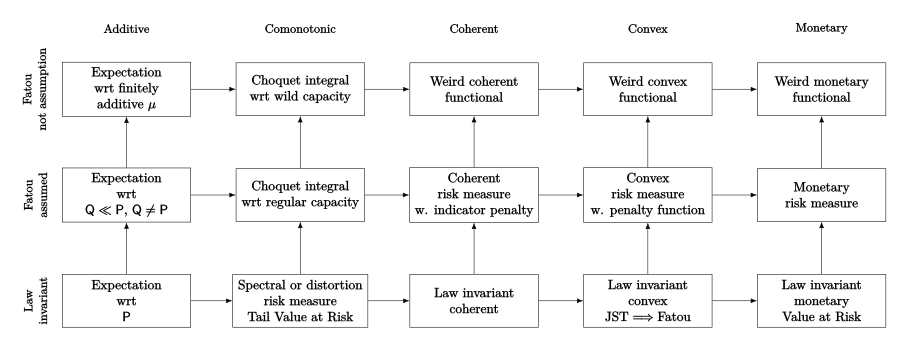{width=100% #fig-atlas}## Populated Atlas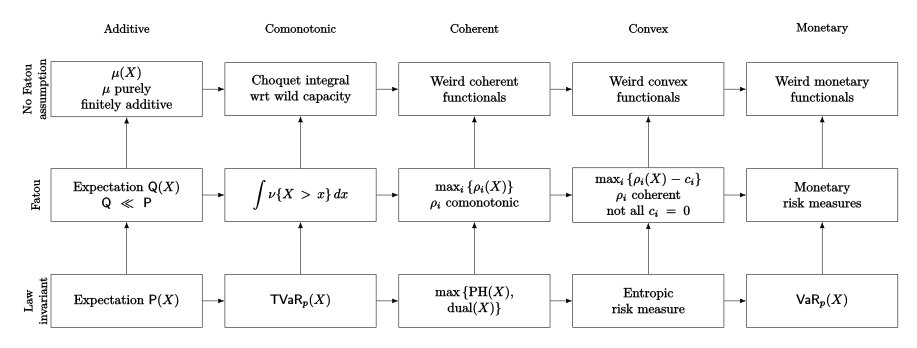{#fig-pop width=100%}## Relationships Between Properties of Risk Measures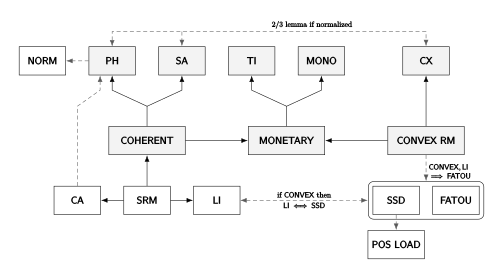{width=80% #fig-classes-of-risk-measures}## Geometric Representations of Penalty Function Epigraphs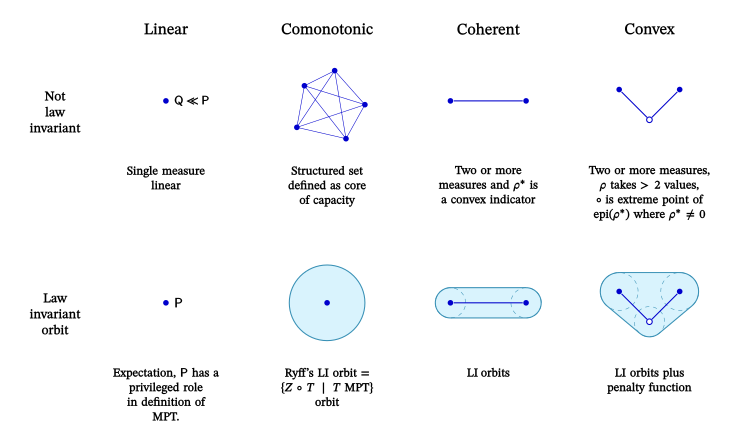{#fig-atlas-epi width=85%}## Atlas Topology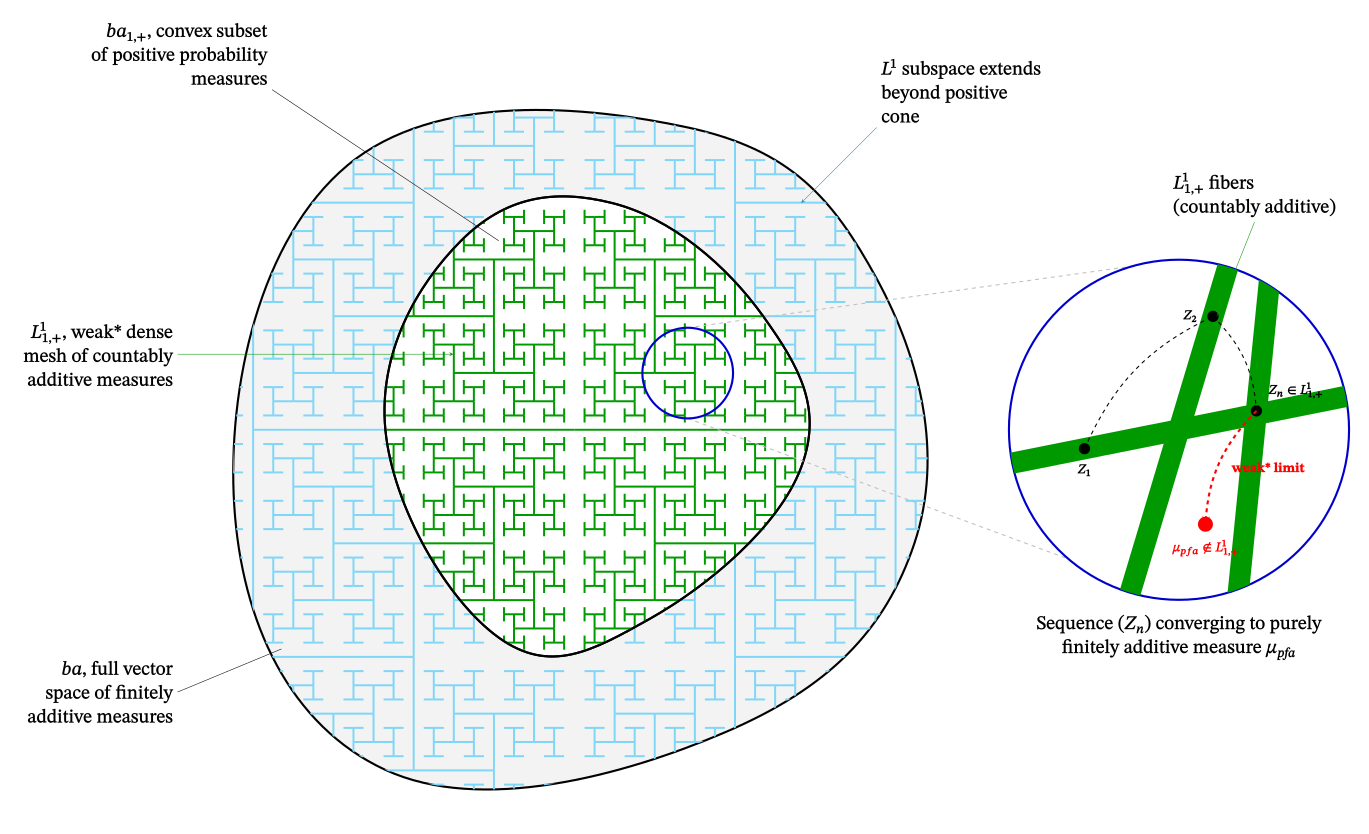{#fig-atlas-topol width=80%}## ConstructionFor a convex, lsc, monetary risk measure $\rho$ on $L^\infty$, with $\alpha$ convex and lsc.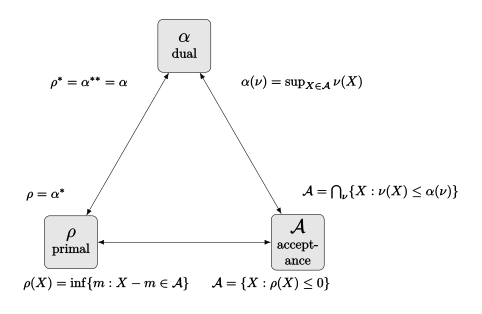{#fig-construction width=80%}## Construction (Arbitrary $\alpha$)Starting from arbitrary $\alpha$ convex and lsc, creating $\alpha_{\min}$.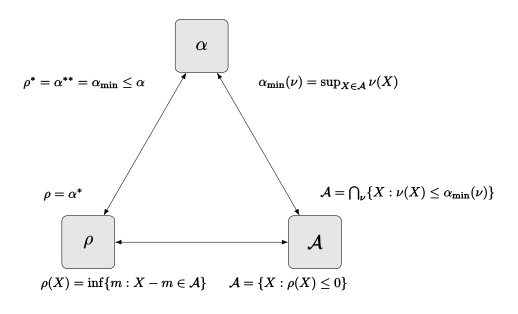{#fig-construction-2 width=80%}## Primal axioms and dual restrictions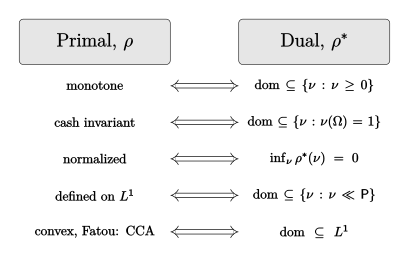{#fig-primal-dual width=80%}## Acceptance Sets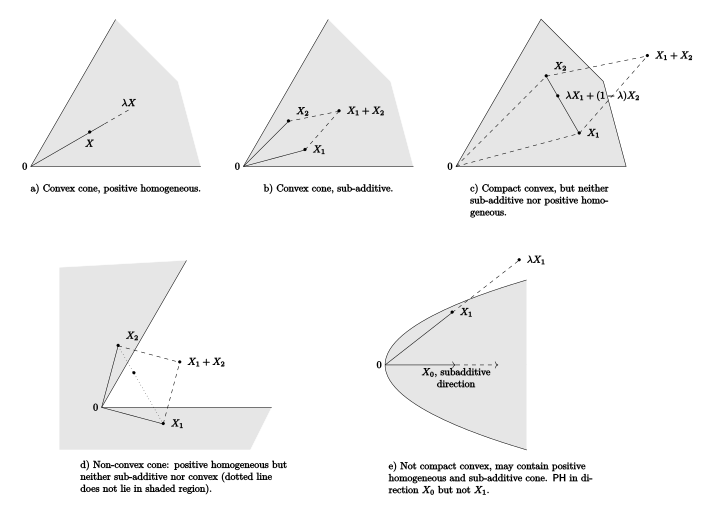{#fig-acceptance width=80%}## Continuity Hierarchy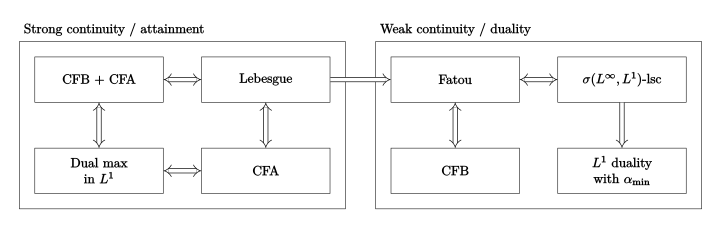{#fig-continuity width=80%}## Convergence Concepts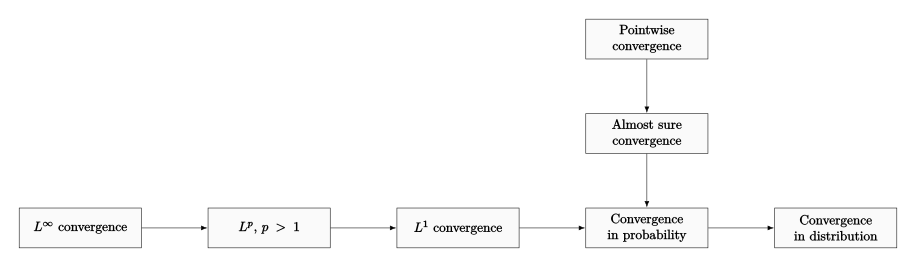{#fig-convergence width=80%}# How To Do Other Things## BumpfToo many actuarial pricing models* over-weight tail catastrophe risk, and* under-weight earnings-hit volatility risk.This behavior drives portfolio steering and reinsurance purchase decisions materially at odds with management's risk preferences.\normalsize## Diagnosis\LargeManagement's complaint is entirely explained by an assumption that the cost of capital is constant.The assumption is often implicit and hidden.\normalsize## Prescription\LargeStop assuming the cost of capital is constant!There are other good alternatives ... enter Spectral Risk Measures (SRMs).\normalsize## Example: Pricing### Keep these numbers in mind!* Market pricing for the total portfolio earns a 15% return on a fully capitalized basis* Premium $P$, capital $Q$, total assets $a=P+Q=\max(L)=100$, and return $r=0.15$ are related by $$P = \mathsf E[L] + r (a - P) \implies P = v \mathsf E[L] + d\max(L)$$ where $v = 1/(1+r)$ and $d=r/(1+r)$ are the discount rate and factor* Facts imply $P=53.565$, loss ratio 87%, and premium to surplus ratio of 1.15:1# Another Section## Slide:::::: {.columns}::: {.column width="40%" .px-3}Left text column1. A2. B3. C:::::: {.column width="60%"}Right text* one* two* three:::::::::### After blue bit* After bullet* @Mildenhall2022, @Mildenhall2022a# References## References::: {.refs}:::












