Slipping Through The Crowd
The rational numbers are everywhere. Between any two real numbers, however close together, there is a rational number. Between any two rationals, there is an irrational number too, so the crowd is not exclusive. But the rationals have a peculiar kind of visibility: they are countable, nameable, enumerable, and easy to put in a line. The irrationals, by contrast, do not queue.
That contrast makes the real line feel slightly paradoxical. The rationals are dense, but tiny: they have Lebesgue measure zero. The irrationals are also dense, but overwhelmingly large in measure. Every interval contains both species, yet almost every point is irrational. Topology and measure are already pulling in different directions.
Oxtoby’s example highlights the tension. Enumerate the rationals as \(q_1,q_2,\ldots\), and around \(q_n\) put an interval whose radius shrinks very fast with \(n\). Repeat that construction with the intervals made smaller and smaller, and intersect the resulting open dense sets. The outcome is a set \(G\) that is topologically huge, because it is a dense \(G_\delta\), but measure-theoretically negligible, because it has measure zero.
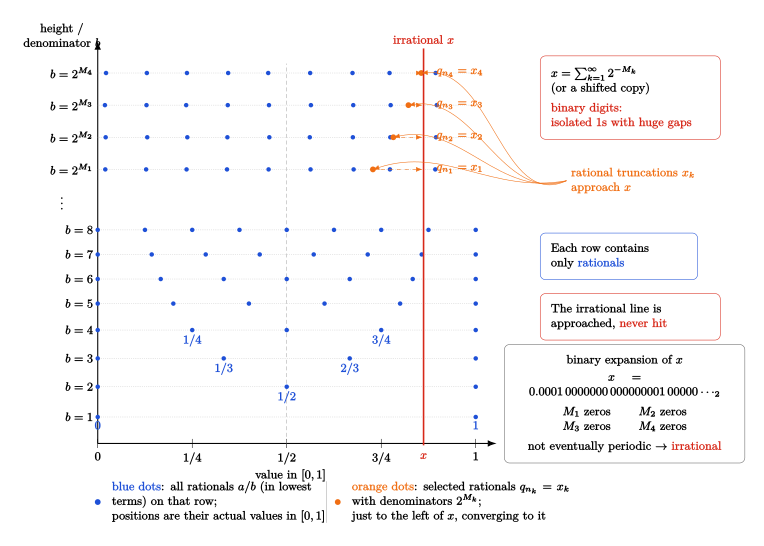
At first glance \(G\) looks like a haze around the rationals, so we might expect its points to be rational, or at least to be hard to describe. But no. If we order the rationals by denominator height, we can build an explicit irrational number that slips through the crowd. Its binary expansion has isolated \(1\)’s separated by enormous deserts of zeros. The finite truncations are rational, appear early enough in the height ordering, and approach the irrational limit so fast that the limit remains inside every one of the shrinking rational neighborhoods.
That is the little trick in this post: we make a number that is visibly not rational, place it inside a set made from rational neighborhoods, and watch it survive an intersection designed to have no measure at all. The point is not that the rationals are numerous. They are not. The point is that density, category, and measure count largeness in different currencies.
The Oxtoby Construction
A standard example in measure and category starts by enumerating the rationals in \([0,1]\): \[ q_1,q_2,q_3,\ldots. \] For each \(N\ge1\), put a very small interval around every rational: \[ G_N = \bigcup_{n\ge1} \left(q_n-2^{-n-N},q_n+2^{-n-N}\right)\cap[0,1]. \] Each \(G_N\) is open and dense. It is open because it is a union of open intervals, and it is dense because it contains every rational number in \([0,1]\).
The total length of \(G_N\) is at most \[ \sum_{n\ge1} 2\cdot 2^{-n-N} = 2^{1-N}. \] Now define \[ G=\bigcap_{N\ge1}G_N. \] The set \(G\) is a dense \(G_\delta\) set, since it is a countable intersection of open dense sets. But \(G\) has Lebesgue measure zero, because \(G\subset G_N\) for every \(N\), and hence \[ m(G)\le m(G_N)\le 2^{1-N} \] for every \(N\). Letting \(N\to\infty\) gives \(m(G)=0\).
This is the point of the example: \(G\) is topologically large, because it is dense \(G_\delta\), but measure-theoretically negligible, because it has measure zero.
Ordering The Rationals By Height
Now take a concrete enumeration of the rationals in \([0,1]\). Write each rational in lowest terms as \(a/b\), where \(0\le a\le b\) and \(\gcd(a,b)=1\). Order the rationals by increasing denominator \(b\), and then, for equal denominator, by increasing numerator \(a\). Thus the rationals appear roughly in order of denominator height. We now construct an explicit irrational number belonging to \(G\) for this enumeration.
A Very Sparse Binary Number
Define integers \(M_k\) recursively by \[ M_1=10,\qquad M_{k+1}=2^{2M_k}+k+10. \] Now define \[ x=\sum_{k=1}^{\infty}2^{-M_k}. \] In binary, \(x\) has a \(1\) in positions \[ M_1,M_2,M_3,\ldots \] and zeros elsewhere. The gaps between successive \(1\)’s grow absurdly fast. For example, the first term is \(2^{-10}\), and the next nonzero binary digit is already at position roughly \(2^{20}\).
The number \(x\) is irrational. A rational number has an eventually periodic binary expansion, except for the usual terminating-expansion ambiguity. The binary expansion of \(x\) has isolated \(1\)’s with gaps tending to infinity, so it cannot be eventually periodic.
Rational Truncations
Let \[ x_k=\sum_{j=1}^k2^{-M_j}. \] Then \(x_k\) is rational, and its denominator divides \(2^{M_k}\). Therefore, in the height enumeration, \(x_k\) appears no later than the point where all rationals with denominator at most \(2^{M_k}\) have appeared. A crude bound is enough. There are at most \[ 1+2+\cdots+2^{M_k}<2^{2M_k} \] fractions with denominator at most \(2^{M_k}\), if we ignore reductions to lowest terms and overcount heavily. Thus, if \(x_k=q_{n_k}\), then \[ n_k\le 2^{2M_k}. \] The approximation error is just the binary tail: \[ 0<x-x_k=\sum_{j>k}2^{-M_j}<2^{-M_{k+1}+1}. \] By the definition of \(M_{k+1}\), \[ M_{k+1}=2^{2M_k}+k+10. \] Hence \[ 0<x-x_k<2^{-2^{2M_k}-k-9}. \] Since \(n_k\le2^{2M_k}\), we get \[ |x-q_{n_k}|=|x-x_k|<2^{-n_k-k}. \] This inequality is exactly what we need.
Membership In Every \(G_N\)
Fix \(N\ge1\). Choose any \(k\ge N\). Since \(x_k=q_{n_k}\), the estimate above gives \[ |x-q_{n_k}|<2^{-n_k-k}\le2^{-n_k-N}. \] Therefore \(x\) lies in the interval around \(q_{n_k}\) used in the definition of \(G_N\). Hence \(x\in G_N\). Since this works for every \(N\), \[ x\in\bigcap_{N\ge1}G_N=G. \] So we have built an explicit irrational number in the dense \(G_\delta\) null set: \[ x=\sum_{k=1}^{\infty}2^{-M_k}, \qquad M_1=10,\qquad M_{k+1}=2^{2M_k}+k+10. \]
Why Sparseness Is The Key
The essential point is not that \(x\) is close to zero. The essential point is that \(x\) has rational truncations \(x_k\) that approximate it fantastically well relative to their height. For the height enumeration, a rational with denominator at most \(2^{M_k}\) appears by about index \(2^{2M_k}\). The next binary digit of \(x\) is placed beyond position \(2^{2M_k}+k+10\), so the tail after \(x_k\) is far smaller than \(2^{-n_k-k}\). Thus, for every \(N\), some truncation \(x_k\) occurs early enough in the rational enumeration, and yet approximates \(x\) accurately enough to put \(x\) inside the tiny interval around \(q_{n_k}\) defining \(G_N\). That is the whole mechanism.
Shifting And Scaling The Example
We can move the example around. Let \(a,b\) be rational numbers with \(b\ne0\), and suppose \[ 0<a+bx<1. \] Set \[ y=a+bx. \] Then \(y\) is irrational, and its natural rational approximants are \[ y_k=a+bx_k. \] The approximation error satisfies \[ |y-y_k|=|b||x-x_k|. \]
The denominators of \(y_k\) are at worst a fixed rational multiple of the denominators of \(x_k\). Therefore their positions in the height enumeration are still controlled by a constant multiple of a function like \(2^{2M_k}\).
By increasing the gaps in the recursive definition of \(M_k\), if necessary, we absorb the fixed constants introduced by \(a\) and \(b\). Thus the same construction gives irrational points in \(G\) located essentially wherever we want inside \([0,1]\).
The phenomenon is therefore not about smallness. It is about very sparse binary expansions, or equivalently, about rational approximations that are much too good relative to the denominator height.
The Number Is Transcendental
The same sparseness that lets \(x\) slip into \(G\) also proves that it is not algebraic. Liouville’s theorem says that an irrational algebraic number \(\alpha\) of degree \(d\ge2\) cannot be approximated too well by rationals: there is a constant \(C(\alpha)>0\) such that, for every rational \(p/q\), \[ \left|\alpha-\frac pq\right|>\frac{C(\alpha)}{q^d}. \] Our number \(x=\sum_{k\ge1}2^{-M_k}\) has rational truncations \(x_k=p_k/2^{M_k}\), and the error is only the remaining binary tail: \[ 0<x-x_k<2^{-M_{k+1}+1}. \] Since \(M_{k+1}\) is chosen much larger than any fixed multiple of \(M_k\), the error is eventually smaller than \(q^{-r}\) for every fixed power \(r\), where \(q=2^{M_k}\). Thus the truncations approximate \(x\) too well for \(x\) to be algebraic of any degree. The number we have built is therefore transcendental. More precisely, it is a Liouville number: an irrational number with infinitely many rational approximations better than every prescribed power of the denominator. Its binary expansion does not merely avoid periodicity; its huge gaps force approximation behavior that algebraic numbers cannot have.